

Cloud Lighthouse and Oaka to co-host AI Trust Forum London
Convened by the Center for Trustworthy AI, this free, one-day event on 1 October 2026 pairs Cloud Lighthouse, the AI lab behind Centru, with Oaka Studio’s partner, go-to-market and ecosystem knowledge.

The Frontier Campus: Whitepaper Synopsis
Eighty percent of AI pilots fail to scale or deliver real business value. This as a call to action for C-level leaders, enterprise architects, and others charged with guiding their organization through the opening vistas of the Age of AI. It highlights a paradox we face today, that despite unprecedented advances and investment in AI, most enterprises struggle to move beyond experimental pilots to meaningful, production-scale AI solutions.

The days of miracle and wonder; AI is the long distance call.
The Boy in the Bubble was the first track of Paul Simon's Graceland, in my view, the greatest musical album released in my lifetime. The year was 1986.
Lately I find myself quietly singing Bubble's refrain.
“These are the days of miracle and wonder. This is the long distance call The way the camera follows us in slo-mo, the way we look to us all. The way we look to a distant constellation that's dying in a corner of the sky. These are the days of miracle and wonder, and don't cry, baby, don't cry, don't cry.”
The genius of Simon's lyrics is in the juxtaposition of tragedy and progress. Nearly 40 years later, the line "these are the days of miracle and wonder" comes to mind when contemplating the nature of this moment in humanity's technological progress. Yet, consider the song's final verse.

A Call to Arms for Trustworthy AI: Can we trust AI?
People and organizations around the world are asking, ”Can we trust artificial intelligence?”. Sure, can we trust AI to be responsible, to generate accurate, trustworthy responses to our prompts? But look more deeply and you will find that truly Trustworthy AI is about so much more. Do we trust that our investments in AI are wise, that we are not throwing effort and money after nonsense? Do we trust that we are moving rigorously, purposefully, and efficiently towards AI’s promised land?

A Moment of Reckoning for Humanitarian and Public Sector
Leaders of these organizations now face a moment of reckoning and—in the chaos of that moment—an opportunity to craft the modern, technologically nimble institutions resilient enough to continue delivering the crucial services upon which their publics so desperately depend. They must use technology to drive out cost, with the core thesis being that to emerge stronger, they must become more modern organizations that use technology to reduce cost and improve services, rather than viewing technology as an ever-expanding cost center. Those that seize the opportunity may survive. Those who let it slip away will fail.
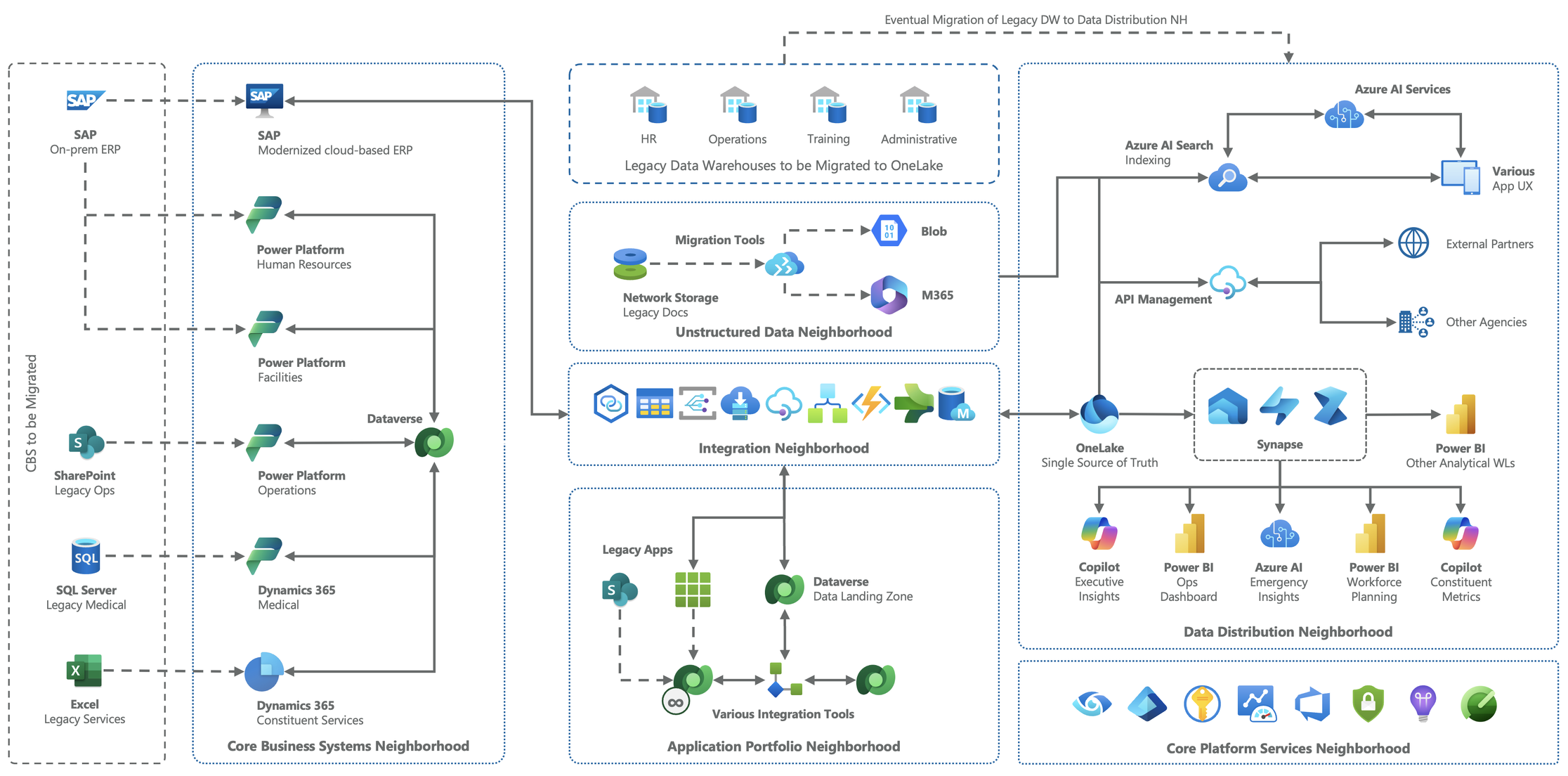
Applying Modern Ecosystem-Oriented Architecture in PubSec
We’ve covered the Principles of Ecosystem-Oriented Architecture (EOA) and Mapping your Cloud Ecosystem in previous articles. We’ll now make the concepts discussed in those previous articles more real in context of Public Sector organizations. To do so, let’s spend some time speaking less about technology and begin describing workloads that incorporate functions and scenarios upon which a typical agency might rely on its cloud ecosystem to perform.
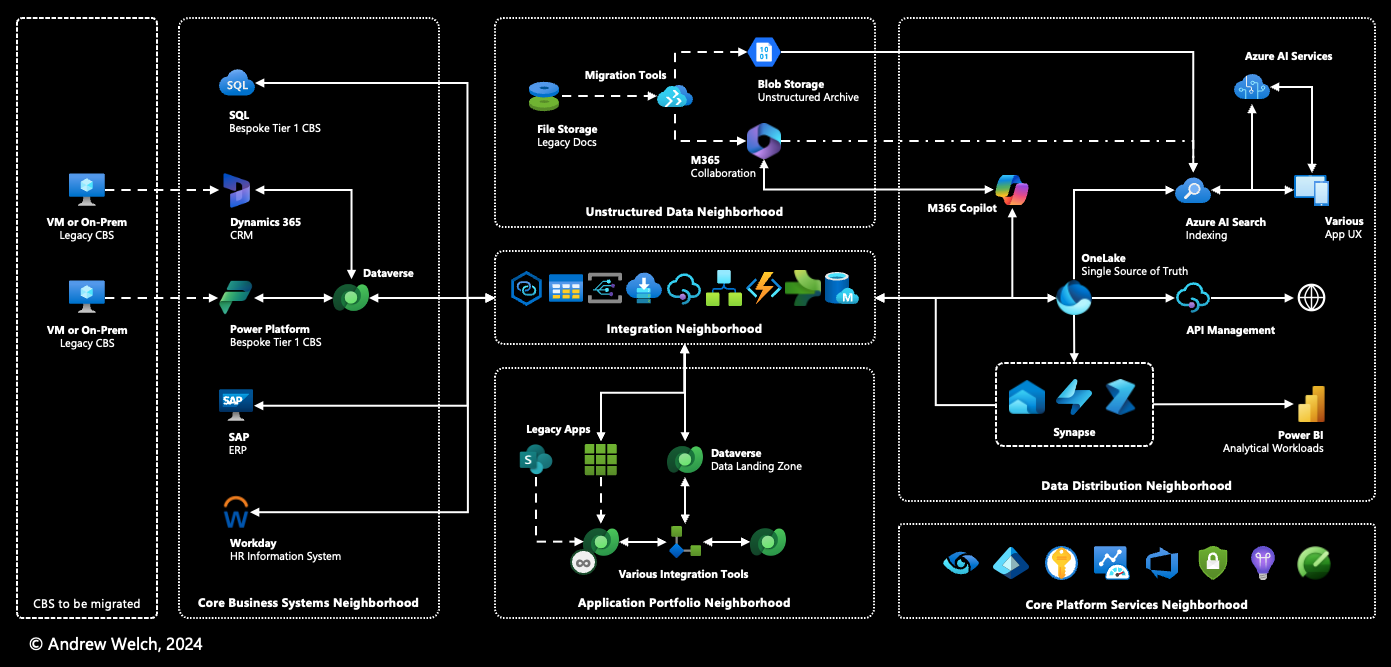
Mapping your Cloud Ecosystem: The Ecosystem Map
"Ecosystem Map" is both one of the 25 dimensions of the AI Strategy Framework and a foundational concept in ecosystem-oriented architecture (EOA), which makes this article doubly important reading for strategic thinkers on both fronts. The “map” metaphor is instructive here. It is used to distinguish an ecosystem map from the various forms of architectural diagrams, nearly all of which tend to include more technical minutiae than a typical ecosystem map. Whereas an architectural diagram provides specific parameters for specific technical solutions, an ecosystem map presents a higher-level, more visionary view of an organization’s cloud ecosystem. This analogy is fundamental to understanding and practicing EOA.

Principles of Ecosystem-Oriented Architecture
We were working with eight to ten years between major disruptions from the dawn of the consumer internet. But these “wave periods”, that is, the time between the crest of two waves, have shortened to three to five years since the rise of the public cloud. It makes sense: As the evolution of computing technology and capacity picks up steam, it similarly accelerates. Innovation begets innovation. Generative AI was only made possible by the incredible computing power and connectivity available in the cloud. Now, AI is further accelerating this pace of change, shortening the time we have available before new waves crash upon the shore. The grace period for organizations to get their act together and position themselves for the next wave is growing much shorter; the margin for error is much narrower.