The Frontier Campus: Whitepaper Synopsis
Author note: This article introduces my new whitepaper, The Frontier Campus. I invite you to read the paper in its entirety, as it includes significantly more details alongside graphics, architectural diagrams, design prototypes, and other illustrations.
Eighty percent of AI pilots fail to scale or deliver real business value.
This as a call to action for C-level leaders, enterprise architects, and others charged with guiding their organization through the opening vistas of the Age of AI. It highlights a paradox we face today, that despite unprecedented advances and investment in AI, most enterprises struggle to move beyond experimental pilots to meaningful, production-scale AI solutions.
How do we break out of this “pilot purgatory” and realize AI’s transformative potential across entire organizations? I’ve grappled with this challenge in my work with big organizations around the world.
I’m excited to introduce The Frontier Campus, a whitepaper that presents a blueprint for globally distributed, multi-agent, multi-cloud AI architecture. The Frontier Campus offers a strategic and technical blueprint through which organizations may deploy multiple AI agents across geographies and technologies, balancing local autonomy with global scale.
Importantly, it translates vision to action, and provides a clear roadmap for implementation, a practical game plan to ensure your AI initiatives aren’t just another isolated proof-of-concept, but a journey towards becoming an AI-powered “frontier firm” built on trust.
The Frontier Campus is based on work at the Center for Trustworthy AI, in fulfillment of our engagement and education mission nurturing a culture of trustworthy AI, and in our development of frameworks, papers, practices, and technical tools that others may use to quickly and confidently embrace AI from a position of trust.
From pilot paralysis to frontier transformation
Successful AI requires more than technological capability. It demands the intentional strategy, a culture of digital literacy and trust, and sound architecture. Trustworthy AI is the intersection of engineering best practice, human ethics, and legal regulation.
But many organizations have poured resources into AI only to stall out because they lack the combination of trustworthy, strategic intent and the rigor to translate that intent into action. Organizations must reject isolated pilots and obviously implausible projects in favor of—as I noted in my piece A Call to Arms for Trustworthy AI —the creation of digital ecosystems that are strategic, safe, reliable, and scalable for the Age of AI.
The Frontier Campus directly addresses this need. It is born from real-world work with global enterprises (including a composite case study of a $1 trillion financial institution) and insights across sectors including financial services, healthcare, legal, energy and utilities, public sector and global non-governmental organizations.
These blueprints envision a campus of AI “agents” spread across a global organization’s technology—and, importantly, cultural—landscape. Acknowledging that different components of a large organization have different needs and constraints, the blueprints seek to empower local teams and regions to develop and deploy AI solutions tailored to their context (local languages, unique market or regulatory requirements, limited internet connectivity, etc.) without sacrificing the benefits of a common, enterprise-wide AI framework.
Crucially, the blueprint blends centralized standards with decentralized innovation. It shows how to create a core set of shared services that provide the foundations for security, data governance, AI model management, compliance, and more. Around this core, business units or regional teams can plug in their own AI agents and data sources, choosing technologies that fit their local needs. This approach ensures each team can innovate quickly with the tools of their choice while still adhering to an overall governance and integration strategy.
For example, imagine a global company where a team in Europe is building a multi-lingual customer facing agent that must comply with applicable EU law, while a team in Asia is building a research assistant agent using a different set of technologies. The Frontier Campus architecture lets both teams develop and run their solutions optimally for their environment while connecting to shared enterprise data, common security controls, and a “trustworthy AI” oversight layer. The entire organization benefits from local innovation without fragmenting into incompatible AI silos.
Three blueprints, global scale and flexibility
The Frontier Campus outlines three blueprints to serve organizations of diverse needs. They are different approaches to implementing the concept, each suited to different circumstances. Think of them as three flavors of the Frontier Campus that organizations can mix and match to suit their needs.
Blueprint A: Open Architecture
This is a vendor-agnostic model that gives quasi-autonomous groups within an organization maximum flexibility, albeit sometimes at a cost. We provide a conceptual reference architecture so that each region or business unit can build its own frontier campus using whatever technologies make sense locally. Whether mixing and matching services from multiple cloud providers or leveraging open-source tools, Blueprint A is about freedom of tech choice. It’s ideal for organizations that demand technological agnosticism and local control. Each business group essentially stands up its own campus following the common blueprint, which ensures a degree of standardization and interoperability. The trade-off is that each group requires the resources to implement and maintain its local “campus”.
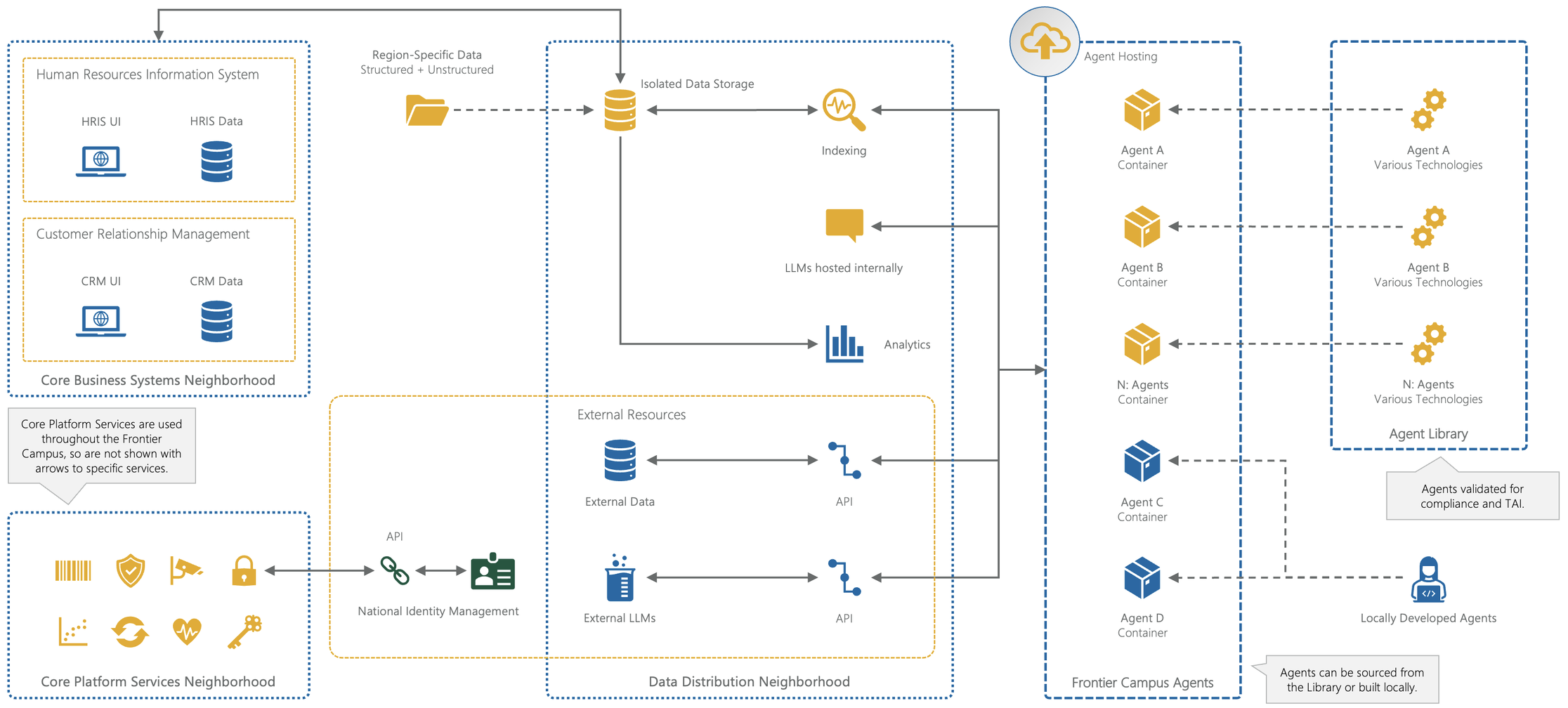
Reference Architecture for Blueprint A's "Open Architecture". Note that this and other diagrams are available in a higher resolution, more legible format in "The Frontier Campus" whitepaper.
Blueprint B: Microsoft Architecture
Many enterprises have invested deeply in Microsoft’s ecosystem, which offers powerful capabilities for deploying and governing AI solutions at scale. Blueprint B takes the open model and adapts it to Microsoft’s cloud and AI stack, including (but not limited to) the Microsoft Agent Framework, Microsoft Foundry, and Agent 365. In this approach, each region or business group may still maintain its own Frontier Campus, but it’s built with pre-selected Microsoft technologies (which can in many cases be scripted to deploy much more quickly than starting from scratch), or a single centralized campus may be built. The advantage is a more turn-key deployment: groups can leverage centrally built components, like pre-trained agents from a central Agent Library, and Microsoft’s tools make it easier to enforce security, compliance, and reliable performance across all your AI agents. This blueprint is well-suited for organizations standardizing on Microsoft for efficiency, while still allowing some local extension and customization of AI solutions.
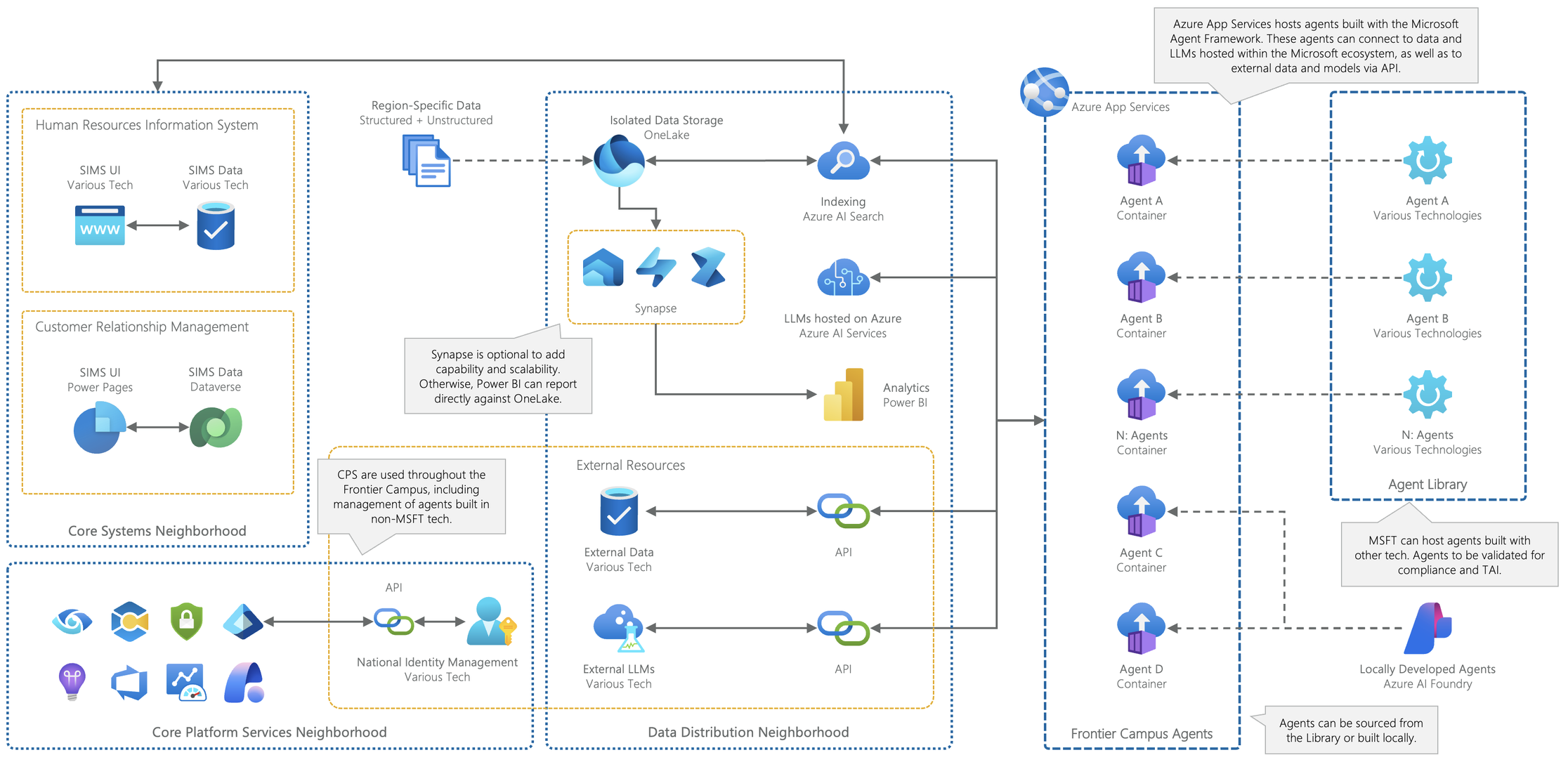
Reference Architecture for Blueprint B's "Microsoft Architecture". Note that this and other diagrams are available in a higher resolution, more legible format in "The Frontier Campus" whitepaper.
Blueprint C: Offline Architecture
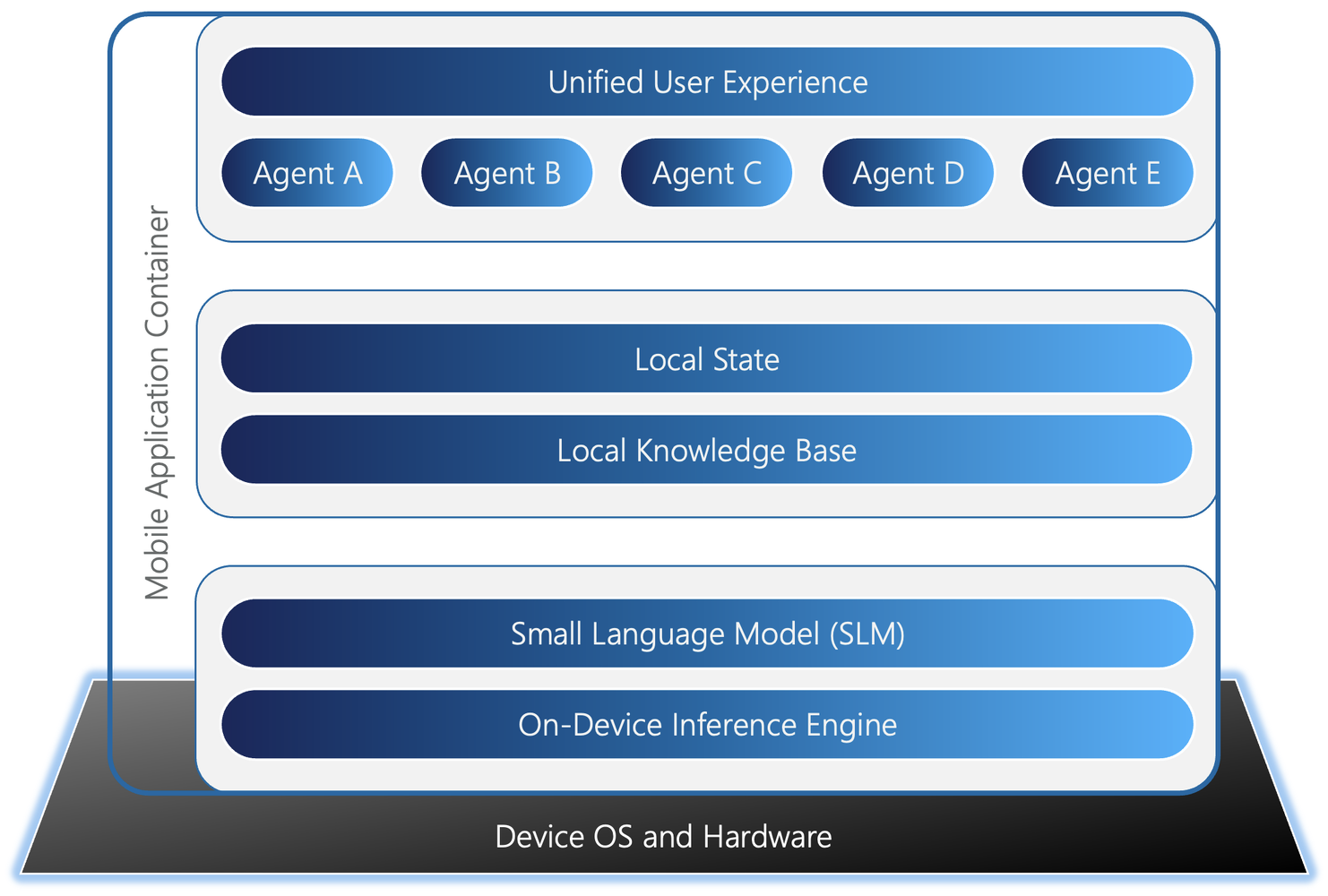
Conceptual architecture for Blueprint C's "Offline Architecture". This and other diagrams are available in "The Frontier Campus" whitepaper.
Connectivity is unreliable or in certain environments. Blueprint C addresses this by enabling AI at the edge, even fully offline.
In this model, the organization provides users with self-contained AI packages that run offline on local devices using a small language model (SLM). Think of deploying small-scale language models and agents onto a mobile device so they can function without internet access.
Microsoft Foundry and the Microsoft Agent Framework are key enabling components both of this architecture and in promoting a “build once, deploy anywhere” approach when mixing and matching blueprints, though Blueprint C can be implemented in non-Microsoft centric organizations, as well.
This approach is critical in scenarios like rural deployments, disaster response, low-bandwidth regions, or high-security settings where cloud connectivity is limited or prohibited. Blueprint C ensures that no part of the organization is left behind, and even the most physically challenging environments can benefit from AI-driven tools. The trade-off here is that without cloud connectivity, these local agents may operate in silos with limited central oversight or data sharing.
Still, for many cases, offline AI capabilities are a game-changer, enabling innovation anywhere.
These three blueprints are not mutually exclusive, and more complex organizations might implement a mix. For instance, a company could primarily use the Microsoft Architecture for most regions to streamline operations, but also provide an Offline Architecture solution for environments with poor connectivity. The Frontier Campus is designed to be flexible; it’s a toolkit of approaches that you tailor to each environment’s needs. Indeed, most organizations will choose one primary model, but having options ensures that AI can be deployed even in outlier scenarios without reinventing the wheel. The unifying factor across all three blueprints is a common set of principles: modular multi-agent design, robust data management, integration across cloud platforms, built-in security and compliance, and the ability for local teams to customize solutions responsibly.
From vision to action: A roadmap for implementation
A core thesis of The Frontier Campus is that architecture is only as good as your ability to execute it. Grand plans won’t help if there’s no clear path to move from idea to production. So, the paper lays out a concrete, actionable roadmap that made sense for the case subject organization, guiding its transformation in horizons spread over six to eighteen months. This roadmap is organized into major priorities and sequenced steps, helping ensure that early AI successes lead to broader, sustainable adoption.
We identified five strategic priorities for rolling out the Frontier Campus in the case organization. Others should think clearly about how to adapt this to their own specific vision. Think of these as the “big buckets” of work on which we must focus to turn vision and architecture into reality.
Build the Foundation. Establish the core platform and governance foundation for your AI ecosystem. This includes the cloud infrastructure, security controls, data storage and pipelines, and an initial Agent Library, the “app store” of AI agents that your organization can develop and reuse. Start small but with scalability in mind (honoring both the “Principle of Restraint” and the “Principle of Evolution”– get an initial version running and improve from there).
Establish Trust and Overcome Barriers. Bake trustworthiness into the architecture from day one. Address key barriers like multilingual needs, cultural differences, data privacy regulations, and ethical AI considerations up front. This might involve implementing robust AI governance and risk management tools, ensuring regulatory compliance based on the jurisdictions in which you operate (e.g., the EU AI Act) and AI risk management standards (for instance, NIST’s AI Risk Management Framework). Overcoming these barriers early creates a strong foundation of trust, which is critical for any AI to be embraced by users, security teams, and regulators—including industry regulations, not solely the AI-specific regulations that have emerged in some jurisdictions—themes I’ve underscored in previous articles as well.
Improve Customer Outcomes. AI must drive real business or mission outcomes. Identify high-impact “big win” workloads where AI agents can significantly improve customer experience, decision-making, or operational efficiency. Then deliver on those opportunities with focused AI solutions. By targeting specific problems (for example, a customer-facing AI assistant to help users navigate services, or an AI tool to streamline an internal process), you demonstrate value quickly and tangibly. Early wins will build momentum, boost adoption, and justify further investment.
Support Colleagues. Your colleagues determine the success of AI (or any technological) transformation. A Frontier Campus isn’t just about technology; it’s about people. This priority focuses on enabling and educating your workforce. Develop training programs and digital literacy initiatives so employees know how to use AI tools confidently and responsibly. Create “ AI champion” teams or a Center for Enablement to share best practices. The Frontier Campus model calls for empowering those colleagues (whether in a corporate office or in the field) to collaborate with AI, trust its outputs, and even build their own solutions with proper guidance. By investing in your people’s skills and addressing their concerns about AI, you ensure the culture is ready to fully leverage new capabilities. In short, supporting your colleagues is supporting your customers, because skilled, AI-empowered colleagues will deliver better service.
Catalyze Regional Implementations. If your organization operates in multiple regions or business units, it’s crucial to jump-start the adoption everywhere. Use a “pilot region” to lead the way, and collaborate closely with that region (or business group) to stand up their Frontier Campus first. This pilot will produce reusable assets: playbooks, technical templates, and a knowledge base that other regions can leverage to accelerate their own deployments. Essentially, turn your first success into a repeatable model. By seeding the Frontier Campus in one region and capturing the lessons learned, you create a ripple effect that will shorten time-to-value when scaling out to additional regions across the globe.
With these priorities in place, The Frontier Campus then maps out a sequenced horizon-based roadmap. The roadmap breaks down specific activities across three horizons. For example, Horizon One (the first four to five months in the case of the case study) might focus on establishing the core platform and delivering a few key AI agents to demonstrate value. Horizon Two then builds on that foundation, adding more advanced capabilities like the Offline Architecture for connectivity-challenged environments and expanding language support to make the AI agents effective in local languages and contexts. Horizon Three looks further out at scaling enterprise-wide, refining governance, and continuously adding to the agent library as new use cases emerge.
A blueprint for the Age of AI
The Frontier Campus is both a practical guide and a call to action. It builds upon a core message I’ve shared before: that to thrive in the Age of AI, organizations need a clear strategy, a scalable ecosystem-oriented architecture, and a commitment to trustworthy AI. By presenting concrete reference architectures and an actionable roadmap, our aim is to empower organizations to break out of the AI pilot trap and start scaling innovations that deliver real value whether as a global financial institution, a government agency, a healthcare network, an NGO on the frontlines of humanitarian work, or any of the many other organizations that will see something of themselves in the paper.
This blueprint is not theoretical. It’s built on hard-won lessons from the front lines of enterprise AI projects. It acknowledges that different teams face different realities, and it equips leaders with multiple pathways to move forward. Crucially, it embeds Trustworthy AI principles into the architecture from the ground up, because scaling AI without trust is not simply unsustainable, it is likely catastrophic. The pursuit of trustworthy, scalable AI must be shouldered by every leader and every organization that wishes to survive and thrive in the coming age.
I invite you to read The Frontier Campus whitepaper and begin adapting these blueprints for your own organization. The paper dives deeper into the technical reference models, previews design prototypes, and elaborates on the roadmap with timelines for implementation. I hope that it will spark ideas for how your organization can fast-track its AI journey to truly become a “frontier firm” in this new era.